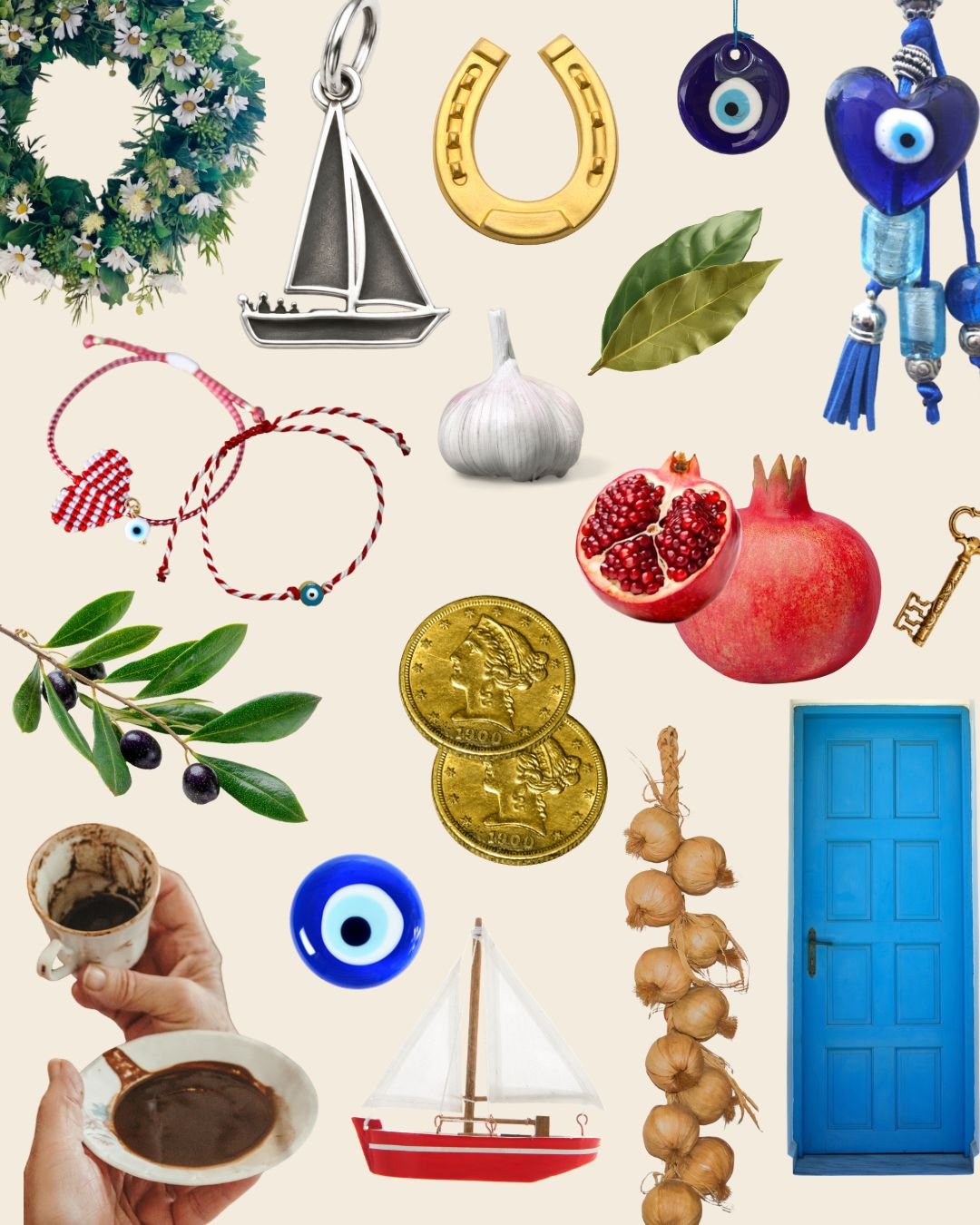
Walk into any Greek gift shop and you will inevitably be greeting with a familiar range of symbolism. A blue eye, a pomegranate, a boat, or maybe even a horseshoe. You might even see a wreath of flowers hanging near the front door. Greek lucky charms have been used for generations to invite good fortune, protect the home and celebrate new beginnings.
They do not all come from the same period – or even the same belief system. Ancient mythology, seasonal agricultural customs, Christianity and folk superstition have accumulated over centuries, sometimes sitting quite happily beside one another.
Some are meant to bring prosperity. Others protect against envy or misfortune. Some belong to a particular day of the year, while others have travelled from the ancient world into modern jewellery, ornaments and the little New Year charms Greeks call gouria.
Here are some of the most recognisable Greek symbols of luck, protection and good fortune.
1. The Pomegranate — Ρόδι
Few Greek symbols say abundance quite as enthusiastically as a fruit containing hundreds of seeds.
The pomegranate has been associated with fertility, prosperity, regeneration and abundance since antiquity. It also appears in one of Greece’s best-known myths: Persephone eats pomegranate seeds in the Underworld, forever connecting the fruit with death, return and the cycle of renewal.
Those ideas survive beautifully in the Greek New Year tradition.
A pomegranate may be hung near the entrance of the home during the festive season before being broken against the doorstep at New Year. As the fruit bursts open and its seeds scatter, they symbolically spread abundance into the year ahead.
It is little wonder that the pomegranate has also become one of the most popular designs for a modern gouri.
Ceramic ones sit in Greek homes. Silver ones become pendants. Tiny versions hang from bracelets and key rings.
An ancient fruit turned into a little wish for a good year.
2. The Doorway — Where Luck Enters the House
Technically, the door itself isn’t a lucky charm.
But the threshold of the home is one of the most important places in Greek good-luck traditions.
Think about how many customs happen there.
The New Year’s pomegranate is smashed at the entrance. The onion is hung above the door. The May wreath goes on the door. And during podariko, the first person to enter the home in the New Year deliberately crosses the threshold with the right foot first, hopefully bringing good fortune with them. This podariko might also apply to a new home too.
There is something wonderfully simple about the symbolism.
The doorway separates outside from inside, the old year from the new, and whatever we want to keep away from whatever we hope to invite in. Maybe that’s why so many protective objects eventually end up hanging beside it!
3. The Onion — Κρεμμύδα
One Greek New Year custom involves hanging a large bulb — traditionally the hardy sea onion — outside the home.
Its remarkable ability to continue producing new growth even when removed from the soil made it a natural symbol of renewal, endurance and new life. The custom is particularly associated with places including Crete, although traditions vary between regions and families.
Here is what I found on Facebook:
The species of onion historically used, scientific name Urginea maritima but known to the peoples of the time as a squill, grew in wild abundance on the isle of Crete. Though not widely appreciated due to its noxious nature, the plant was believed to have mystical powers of regeneration because of its ability to regrow. For pagans, these magical powers were a gift from the God Pan, patron of nature and the wild; offering the squill bulbs to him were a means of asking for his favor. Christianity began this practice with the same reasoning, and now today you might see foil-wrapped onions perched over door mantles, warding off bad spirits and inviting a year of plenty.
In one version of the tradition, parents even use the onion to gently tap their children’s heads on New Year’s morning, passing that symbolic strength and growth on to the next generation.
4. Garlic — Σκόρδο
Garlic sits a little more firmly in the protection category than the good-luck category.
In Greek folk belief it has long been used as an apotropaic symbol — something intended to ward off harmful influences, particularly the evil eye.
That association is strong enough that garlic itself appears among the motifs used on modern Greek gouria. It’s no wonder Greeks LOVE garlic on everything.
And here’s something I didnt know,
5. The Mati — Μάτι
Probably the most internationally recognisable Greek protective symbol is the mati, or evil-eye charm.
Despite often being sold today as a generic symbol of “good luck”, its traditional purpose is more specific: protection against the evil eye, or matiasma — harm believed to arise from an envious or admiring gaze.
Belief in the evil eye stretches far beyond Greece and is found throughout the Mediterranean and Middle East. Eye-shaped amulets themselves have an extremely long history in the wider region.
In Greece, the familiar blue eye can appear almost anywhere: jewellery, homes, cars, businesses and even attached to babies’ prams. It’s said this version has its origin in the Ottoman era, hence why they are just as ubiquitous in Turkey.
6. Martis — Μάρτης
On the first day of March, another little protective object appears: the Martis bracelet.
Traditionally made from twisted red and white thread, it is worn around the wrist during March and is said to protect the wearer — particularly children — from the strong early spring sun.
The custom is part of a wider family of spring thread traditions found across the Balkans, and versions of the red-and-white bracelet remain very much alive today.
Martis isn’t really a year-round good-luck charm, but you can wear it all year if you want (I do!).
In essence its symbolism is about Winter ending and Spring arriving – very similar to broader European folk traditions, and it might not be a coincidence.
7. The Horseshoe — Πέταλο
The horseshoe isn’t exclusively Greek; far from it – but it has found a comfortable home among Greek lucky charms.
Horseshoes have long been used in European folk tradition as symbols of good fortune and protection, often placed near entrances. In modern Greece, the horseshoe regularly appears in gouri designs alongside pomegranates, coins and the mati.
Different explanations have been attached to it over time: its iron construction, its crescent-like shape and its association with strength have all contributed to its reputation.
Today you are more likely to find a tiny gold or silver horseshoe on a New Year ornament than an actual one nailed above a Greek doorway (depending on where in Greece you are, though). The symbolism has survived.
8. The Olive — Ελιά
It would be difficult to choose a plant more deeply woven into Greek identity than the olive tree.
According to Greek mythology, Athena gave the olive tree to Athens during her contest with Poseidon for guardianship of the city. The olive consequently became one of Athena’s great symbols and was associated with peace and victory.
Olive wreaths were also awarded to victorious athletes at ancient Olympia. But the symbolism goes beyond winning.
As an evergreen tree that survives poor soil, heat and age it’s the very symbol of continuity, resilience and prosperity.
Ancient Greeks even decorated branches with fruit and offerings and carried them in rituals intended to bring prosperity into the community and household. So when olive leaves appear on contemporary Greek jewellery and charms, they are carrying quite a lot of cultural history for such a small leaf.
9. Laurel — Δάφνη
If the olive says endurance, the laurel says achievement.
Laurel was sacred to Apollo and became closely connected with victory, honour, recognition and purification in the ancient Greek world. Victors at the Pythian Games at Delphi were crowned with laurel wreaths. Its association with success became so enduring that we still use expressions such as “resting on your laurels” today.
Interestingly, laurel also had a protective and purifying role. Ancient branches and wreaths could be associated with cleansing sacred spaces and homes, while decorated branches were sometimes hung at entrances.
It may not be the first object modern Greeks reach for when someone says “lucky charm”, but as a Greek symbol of success and favourable fortune, its credentials are difficult to beat.
10. The May Day Wreath — Μαγιάτικο Στεφάνι
On Protomagia — May 1st — Greeks traditionally head outdoors, gather flowers and greenery and weave them into a wreath.
Then, naturally, it goes on the front door.
The May Day wreath, or magiatiko stefani, celebrates spring, fertility and the regeneration of nature. Modern celebrations preserve echoes of much older agricultural and seasonal traditions centred on the return of warmth and the fruitfulness of the earth.
Traditional wreaths weren’t necessarily made from pretty flowers alone. Depending on the region, people incorporated wheat, fruit-tree branches, nettles, onion or garlic — plants carrying ideas of fertility, abundance or protection.
The finished wreath traditionally remains on the house until around the feast of St John in late June, when old wreaths may be burned in midsummer fires.
While it is decorative, it is also a ritual welcoming abundance back through the door.
11. The Lucky Coin — Φλουρί
This one might be the most exciting lucky charm of all. The one you can eat your way towards!
At New Year, Greeks cut the vasilopita, the cake or sweet bread associated with St Basil’s Day. Hidden somewhere inside is a coin known as the flouri. Whoever discovers it in their piece is considered the lucky person of the year.
Coins also appear as motifs on gouria and jewellery, carrying the obvious associations of prosperity, fortune and abundance into another form.
But nothing quite compares with watching everybody inspect their slice of vasilopita suspiciously while pretending they aren’t desperately hoping they’ve won.
12. The Karavaki — Καραβάκι
Before Christmas trees became widespread in Greece, many Greek households celebrated the festive season by decorating a small wooden boat known as a karavaki.
The tradition is especially associated with Greece’s islands and coastal communities, where the sea has shaped everyday life for centuries. But it wasn’t just for families whose loved ones worked as sailors or fishermen. To understand the significance of these boats, you must understand that travelling on these boats was essential to survival, especially on the islands. Inter-island travel for goods, trade, medical purposes and visiting family was common and essential. As a person with Greek island ancestry and deep family history with boats, I have heard many personal stories about this.
The little boat came to symbolise safe journeys, protection at sea and the hope of a happy homecoming.
Decorated with lights, ribbons and festive ornaments, the karavaki also became a symbol of Christmas and the arrival of a new year.
Unlike the pomegranate or mati, the karavaki isn’t traditionally a charm intended to attract wealth or ward off the evil eye. Its symbolism is more closely connected to hope, family, safe passage and renewal.
Today, decorated boats can still be seen in Greek homes, town squares and Christmas displays, particularly in maritime communities. Small ornamental versions have also found their way into modern festive decorations and gouria.
For Greeks living far from their ancestral homeland, there is something especially meaningful about a little boat representing the journey between leaving and returning.
A reminder that sometimes the greatest fortune is simply making it home. And it’s a story that stretches back 2000 years in this small peninsula which has shaped so many of our lives.